Skip to content
SUSTAINABLE “HERITAGE” DESIGN
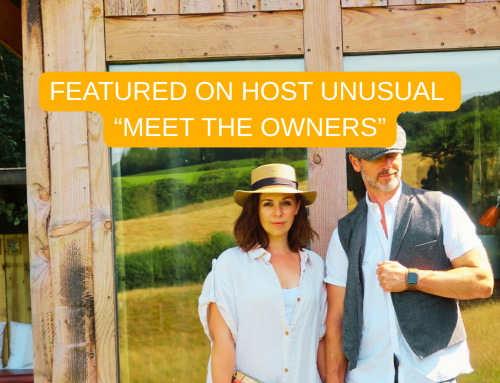
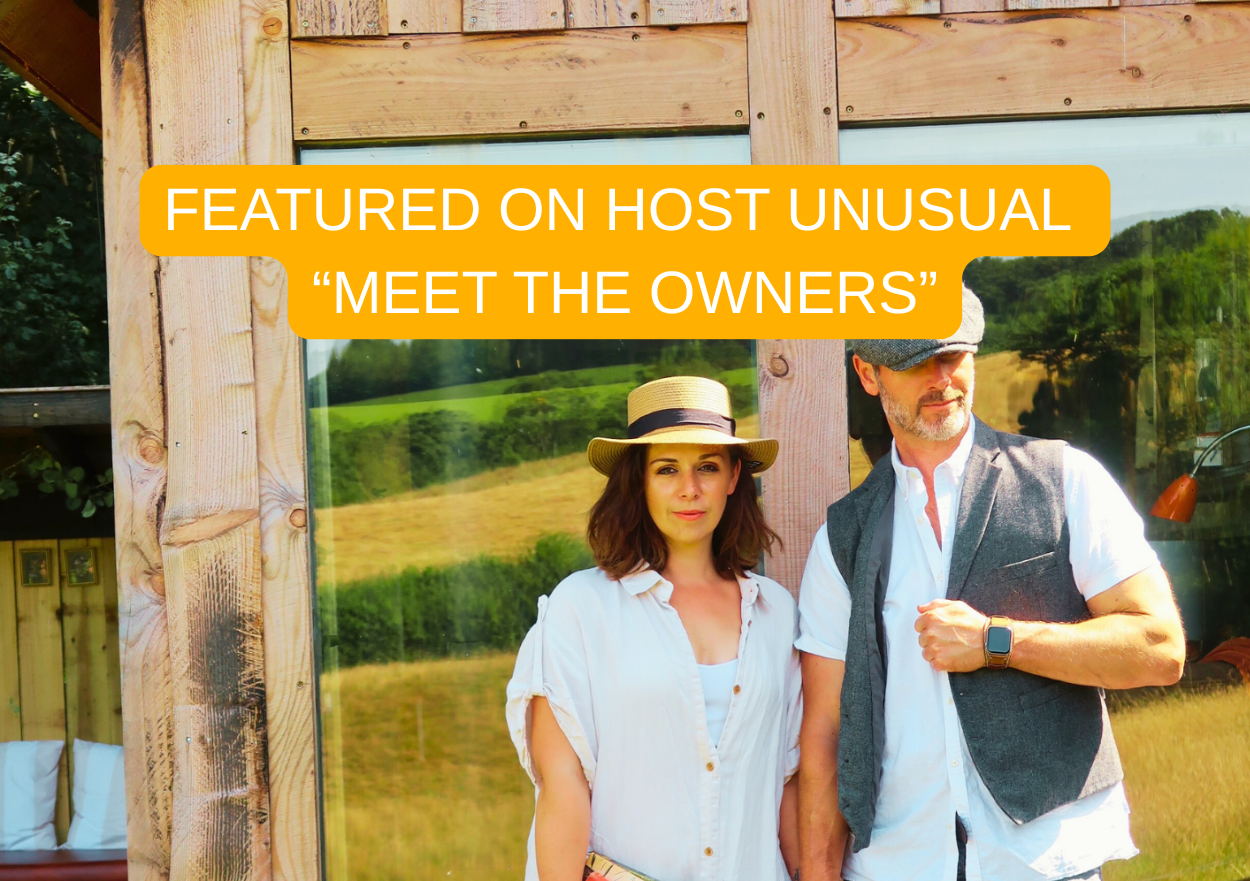
When Nick and I decided that the farm was where we wanted to make “home”, it was clear that it was going to be a long term project. A project that would mean we would constantly have a never-ending “to-do” list!. Combine this with children and animals, the road hasn’t been the smoothest of journeys, but certainly an adventure! The farm itself stretches out across 45 acres of gorgeous Devon countryside and where the main yard houses buildings we have lovingly restored. We are still in the process of trying to do better by the land we serve.
Generally, as a farm, we are two years into a tree planting project with The Woodland Trust, increasing our woodland by 4 acres, to 20 in total, and have hosted a group of ecologists twice this last year who are assessing whether we will gain County Wildlife Status. They have recorded not only an Otter in our pond, but also some rare Lichen, all very exciting! We’ve also included local schools to help us tree plant and have so far planted over 2500 trees. We’re part of the Sustainable Farm Incentive and amongst several environmental objectives, have recently seeded approximately 11 acres with a multi species herbal ley to increase biodiversity. We tap Birch Sap every spring which is sold at Totnes market to raise funds for a local environmental CIC.
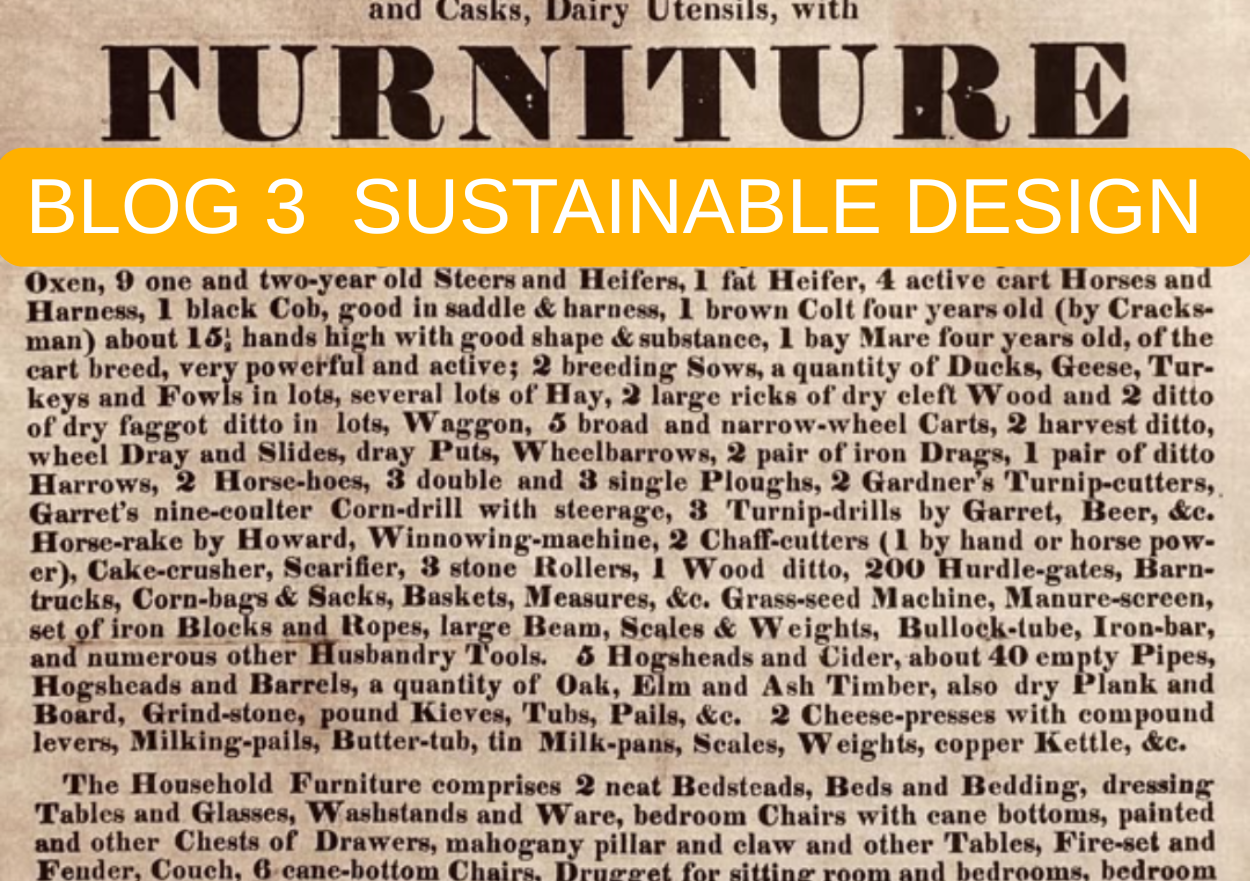
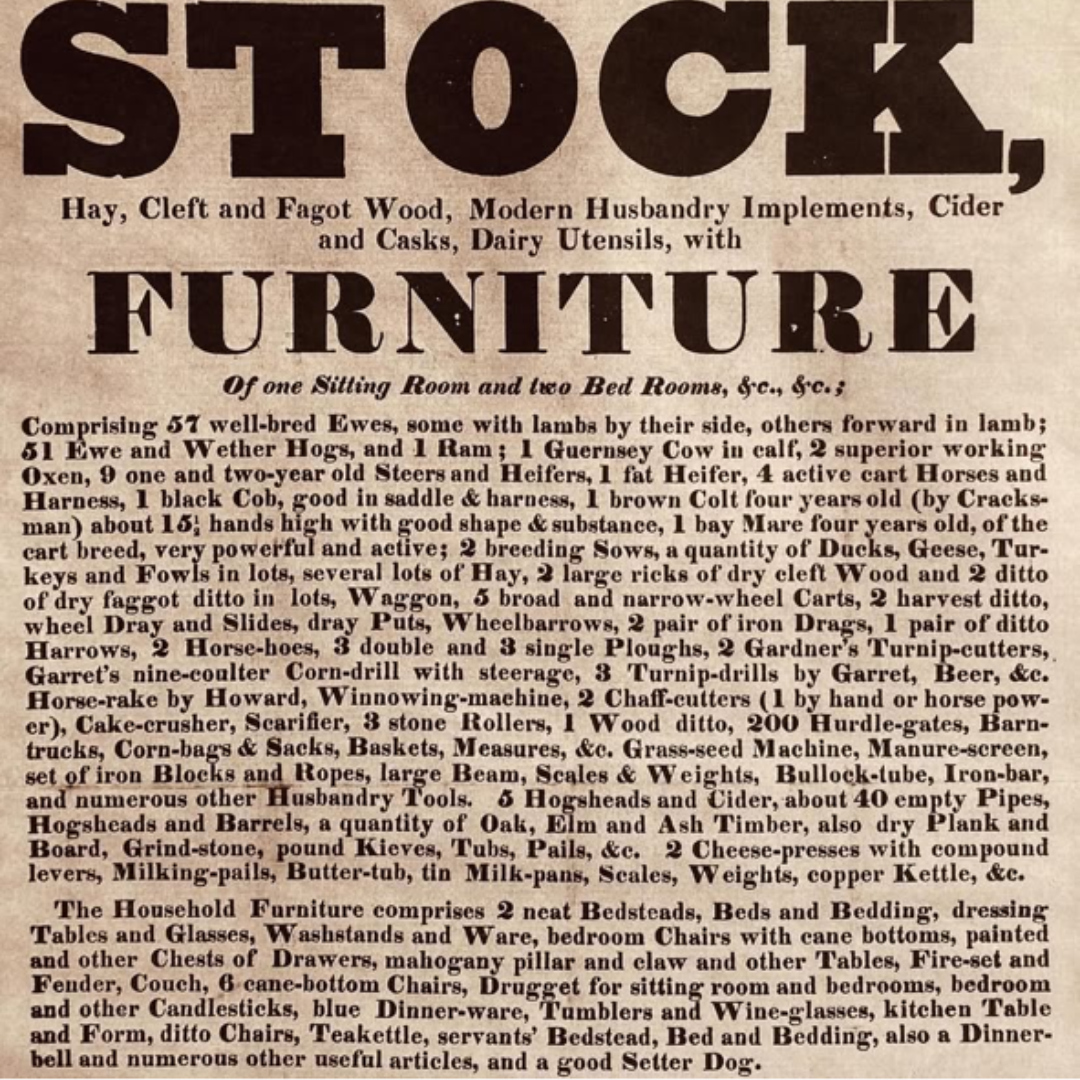
When we began our journey of restoring the farm, we were incredibly lucky to have a nugget of priceless information! A friend who had visited Exeter cattle market telephoned us one day to say he’d seen a poster of the farm where the original farm auction sign had details about what had previously been sold. Below you can see the contents – can you believe they even through in the dog?! Remarkably it detailed not only the farm machinery and equipment, but the household contents. We don’t feel these items went very far, as we’ve been uncovering them ever since, with a passion to use them in future ventures. This really has become the cornerstone of our design work, as we seek to uncover the “lost” in old farm stores and give them a new lease of life. When we came to build the cabin, we knew that it was important to reflect the farm within it, but for the cabin to also have its own feel.
Sustainable ways The Book Nook celebrates
“Heritage Design”.
“The preservation and celebration of historical and cultural elements, creating spaces that reflect a sense of identity and continuity”
This is a statement which refers to the meaning of Heritage Design. But for us, Heritage Design is more about the emphasis on HERITAGE. It’s about how we reuse what has gone before us, what has been left from the past and how to instil a sense of “make, mend, do”, something we feel has been lost in an age of fast consumption and the desire to buy new.
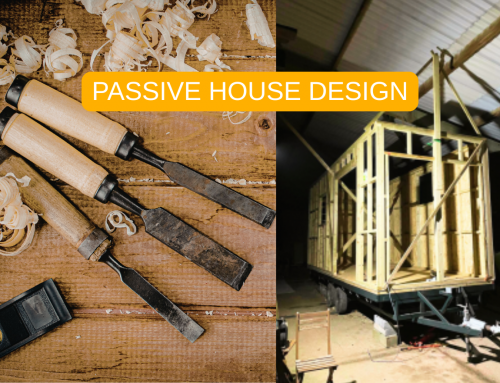
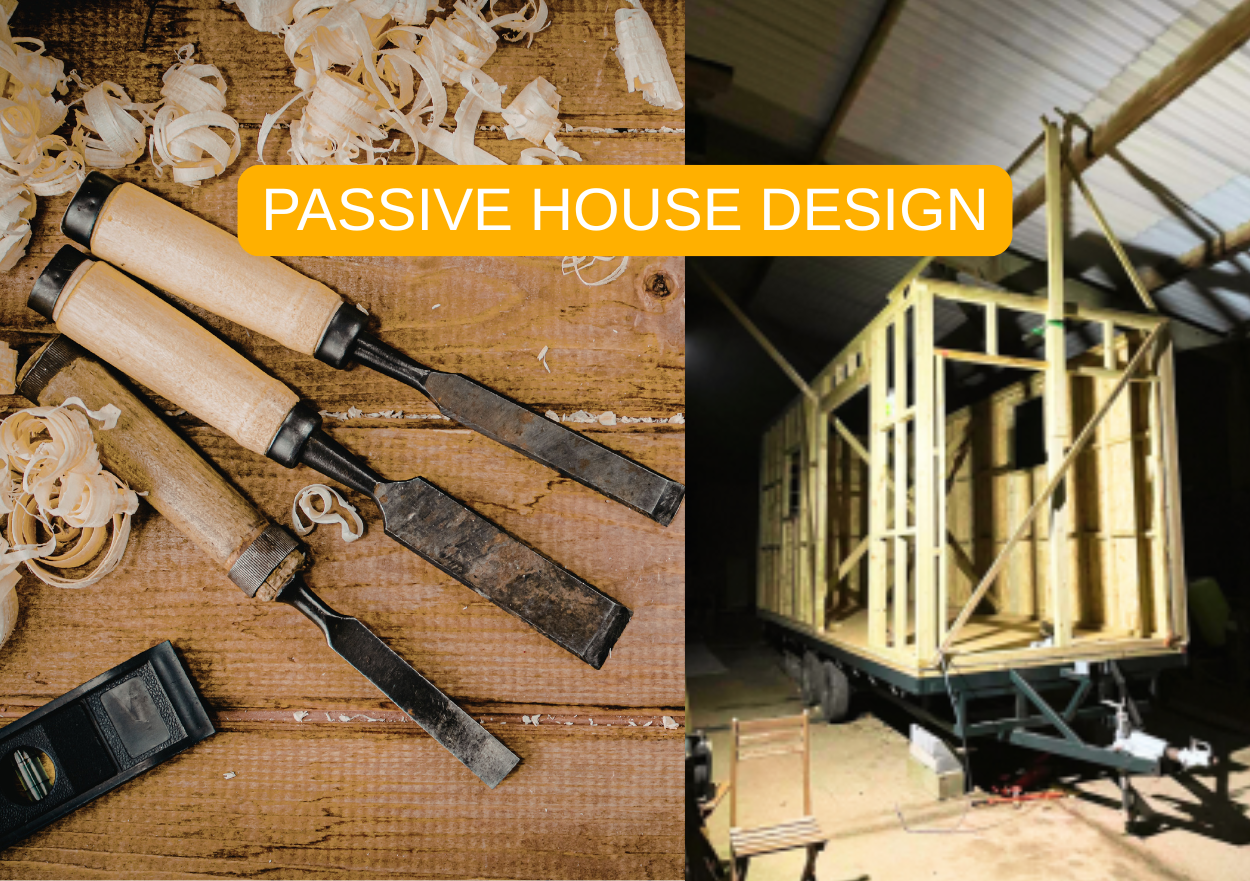
The Cabin began it’s life as a second hand trailer on wheels and we realised, that by seeking out building materials, items lost to the past and by allowing these materials to inform our design choices, we could make something truly unique. Here’s a list of ways in which we utilised salvaged items within the build and why they were important to us.
The Bathroom – the bathroom was inspired by Enid Blyton, because we uncovered family books in a box – the majority had been damaged by water and as such, we slowly took to drying some of the pages so that we could use them as decoupaged wallpaper. We even found a ceramic “Timmy the dog”, who now sits proudly on the bathroom shelf! We left family notations on some of the paper, as a nod to a life lived growing up on the farm,
The Kitchen – salvaged worktops, copper pipes, fabric scraps, leftover paint samples, unloved books, second hand upcycled tiles and thrifted crockery means this room is incredibly eclectic. We wanted this room to feel as if it came straight out of a Brambly Hedge storybook, with pots and pans hanging from the ceiling. The beams are exposed and all of the fixings came from my late fathers toolbox, where miraculously we had just the right amount of fixings to finish the project, without having to buy new!.
The Living Room – is a reclamation heaven as we found so many treasures in old stores, notably the library shelving unit, a broken typewriter which is now the welcome box, old tiles, metal partitions for the stove grate and even the windows and doors. We salvaged these from an old conservatory that used to sit on the back of our cottage.
The Bedroom – Perhaps my most favourite room in the cabin. The bedroom partition was made from our daughters old cot bed frame. The authors headboard was made from a piece of wood we discovered near the chicken coop. We found two little single headboards in a store and these immediately reminded us of Peter Pan. I suppose the more we uncovered, the more there was a link to childhood stories. The window was second hand and all of the decoupaged walls were made from recycled papers. Even the beam which keeps the roof up came from our old kitchen.
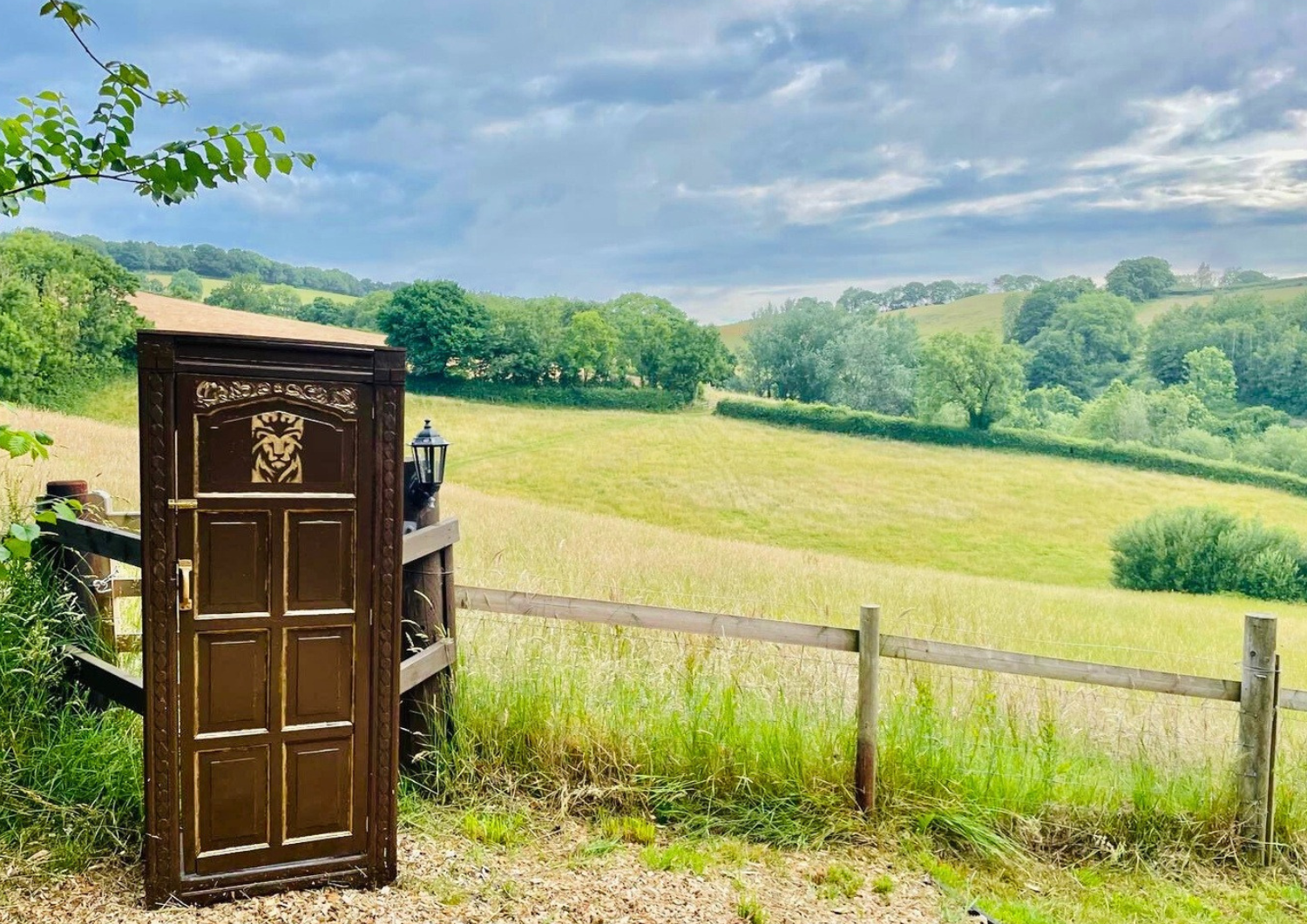
The one item I knew was a non-negotiable was the Narnia wardrobe, as the more we leant into the literary feel, the more I felt we needed to remind others of the magic its still possible to feel, even as an adult. For me C.S Lewis’ books were a part of my childhood, with The Chronicles of Narnia, a firm favourite. I’m not going to sugar coat it, but the Narnia door was also a huge bone of contention as Nick just wanted the build finished! Several arguments later and the door is still something that continually needs love and tlc! It sits at the foot of the hillside and during summer months you can walk through to the woods. It’s magic and was made from our sons old baby wardrobe. Even Lucy Pevensie’s “fur” coat still hangs inside.
I suppose for us, the magic is in the small details. We feel that when you book somewhere to stay, a lot of places are now carbon copies of each other. Often the same artwork, or the same feel. The majority of items are bought new.
For us, we wanted every corner to tell the story of its past and for guests to recognise something new each day. We really hope you feel happy, relaxed, cosy and looked after when you stay and that the cabin becomes part of your own story.
Share This Story, Choose Your Platform!
Page load link